
Why your EHR export is a mess, and why software goes quiet about what it can't read
By Jermaine F. Barker · Founder & CEO, JMCB Technology Group
A few months back I was building a resume parser for a career assessment tool, the part that reads whatever CV a job seeker uploads, PDF, Word, OpenDocument, plain text, and turns it into structured data an AI can work with. Somewhere in week one I ran into a problem that had nothing to do with AI at all: some of those files don't parse cleanly. A PDF exported from an odd tool. A Word document with a table nested inside another table. The parser does its best, pulls out what it can read, and quietly moves on. What it can't read just isn't there anymore, and nothing on screen tells you that.
That's a small, low-stakes version of a problem that shows up constantly in a much higher-stakes place: electronic health records. Once you've built the small version and had to actually solve it, you start noticing the big version everywhere, and in healthcare it isn't a resume that loses a bullet point. It's a patient's medical history that loses a diagnosis, a medication, or a lab result on the way from one system to another.
The failure mode is always the same shape
Here's the pattern, and it repeats everywhere I've seen it. A piece of software receives a document in some format it mostly understands. It reads the parts that map cleanly onto its own data model. The parts that don't map cleanly, an unusual field, a formatting quirk, a section the receiving system just never bothered to support, get dropped. Not flagged as dropped. Not logged as a partial success. Just gone, while the process that dropped them reports back that the import completed fine.
For a resume, that's an annoyance. For an electronic health record moving from a hospital's system to a specialist's system, or into a patient's own portal, that's a doctor making a decision without a piece of information they had every reason to believe was there. Nobody built it that way on purpose. It's what happens when a very old, very common architecture pattern, best-effort parsing with silent failure, gets applied to records where silence is the expensive part.
The data backs up how common this actually is
I want to be careful here, because this is exactly the kind of claim that's easy to overstate with a vibe instead of a number. So here's the real one. A study published in JAMA Network Open in November 2025, "EHR Interoperability Experiences Reported by Family Physicians," surveyed 8,122 family physicians using data from the 2024 American Board of Family Medicine certification questionnaire. Fewer than 15 percent reported what the study defined as an ideal interoperability experience, meaning they could often obtain, find, and reconcile external data inside their own EHR. Broken down by data type, it ranged from 19 percent for encounter documents down to just 8 percent for test results coming from an outside hospital.
Read that again slowly. These aren't patients struggling with a confusing portal. These are the physicians themselves, inside the systems built specifically for this job, saying that most of the time the external data either doesn't show up, is hard to find, or doesn't reconcile cleanly with what's already there. That gap between "the export technically succeeded" and "the information actually made it across intact" is the whole problem, and it's the norm, not the exception.
At the same time, more patients than ever are actually looking. Per the ONC data brief on patient portal and health app use, published by the Assistant Secretary for Technology Policy in July 2025, 77 percent of individuals were offered online access to their health information in 2024, up from 73 percent in 2022. More people are opening their own records every year. If those records quietly dropped something on the way in, more people are now in a position to notice, and fewer are positioned to know what they're not seeing.
Why the export still says success
This is the part that took me a while to internalize, and it's the same lesson from the resume parser, just with worse consequences. A document export can be schema-valid and still be semantically empty in the places that matter. A C-CDA document, the standard clinical document format most certified EHRs produce, can pass every structural check a receiving system runs on it, the tags are all in the right place, the required sections exist, and still carry a narrative note that never gets parsed into anything a human on the other end can act on. The file is valid. The information inside it might as well not exist for the physician trying to use it.
Nobody involved is doing anything wrong on purpose. The exporting system met its certification requirements. The receiving system handled the fields it knows how to handle. The gap lives in the space between what the format technically allows and what any given piece of software actually chose to build support for. That gap doesn't show up as an error, because nothing in the pipeline was designed to notice it. It just shows up later, as a doctor asking a patient a question the patient already answered somewhere else.
The nothing-dropped rule
Building that resume parser, I landed on a rule that I now think should apply a lot more broadly than resumes: never let the system quietly discard something it couldn't handle. Nothing the AI says about a candidate's resume is allowed to appear unless it can be traced back to the source document, and anything that can't be is left out rather than presented as if it were verified. The point isn't that the parser is perfect. It isn't. The point is that the system doesn't get to pretend it is.
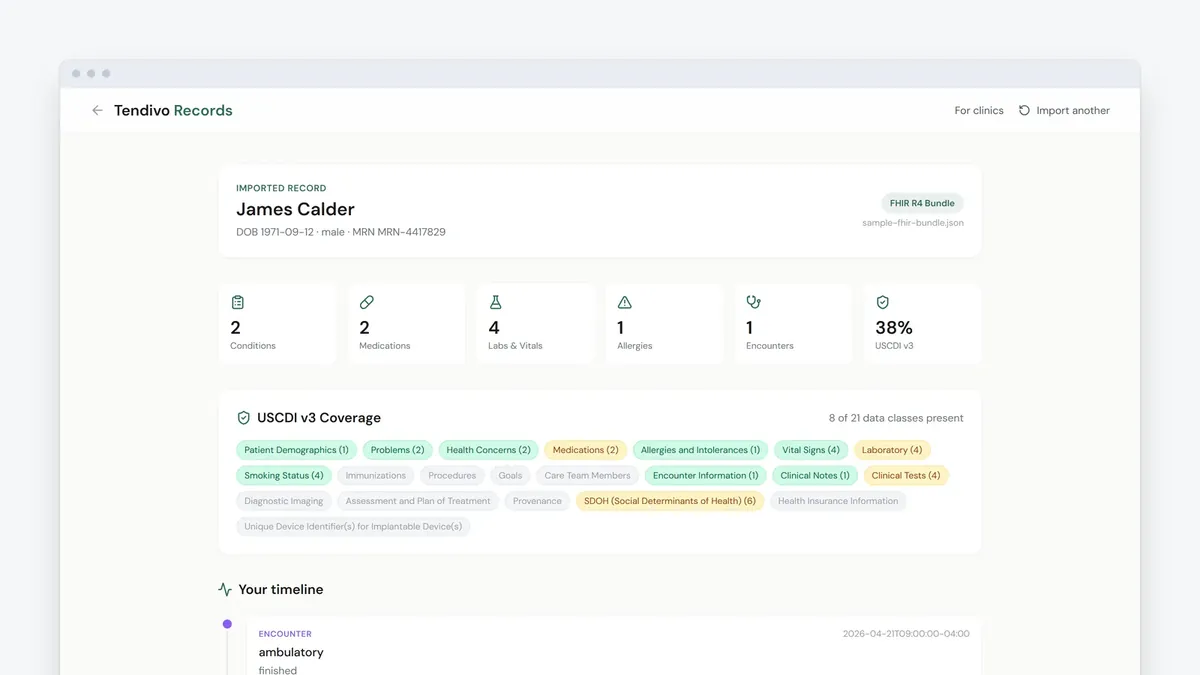
Healthcare software could adopt the same discipline without waiting for a new interoperability standard to save everyone. Flag what didn't parse instead of dropping it. Show a "this section couldn't be reconciled" marker instead of a blank space that looks identical to "there was nothing here." Give the physician, or the patient reading their own chart, a way to know the difference between "confirmed absent" and "we couldn't read it." That one distinction is not a hard engineering problem. It's a design decision that most systems simply never made, because success metrics for these exports have historically measured whether the file validated, not whether the meaning inside it survived the trip.
What this means if you're building or buying health software
If you're evaluating a system that claims interoperability, ask the boring question nobody asks in the sales demo: what happens to the data it can't parse? Not what happens to the data it can, every vendor has a good answer for that part. Ask about the failure path. A vendor with a real answer will tell you exactly what gets flagged, logged, and surfaced. A vendor without one will change the subject back to how many data types they support, which is a different question with a much less honest answer underneath it.
The nothing-dropped standard is a low bar in one sense. It doesn't require solving interoperability. It just requires telling the truth about where it currently fails, instead of letting a green checkmark stand in for a completeness nobody actually verified. That's a smaller ask than it sounds, and almost nobody is doing it. If you're trying to figure out where your own systems are quietly dropping things they never flagged, the free AI readiness assessment is a five-minute way to start finding out before a patient, or a customer, finds out for you.